Friday, October 02, 2009

Cilantro and its Enemies

A certain percentage of the population, it turns out, has a fierce hatred for cilantro. I had this in the back of my mind as I told a couple of friends about a delicious drink I had at a Brooklyn restaurant, a muddled cilantro and jalepeno-infused tequila concoction.

"I hate cilantro," one friend said. "Apparently I'm one of those rare people for whom cilantro tastes like bleach or dish soap."

My friend is not alone. Not even remotely. How did I not hear more about this before?

ihatecilantro.blogspot.com (there used to be another cilantro hater's website, ihatecilantro.com, but it is now a virus-generating mess -- don't go there.) has a handy "guide to cilantro-free restaurants." The blogger tries to mitigate her hatred by pointing out that she loves so many other things:
"...how could I or you or anyone so passionately hate something as much as cilantro without loving so much else, in fact most else, of nature's bounty, as foodies insist on calling it, or food, as I like to think of it."
People get weird about their food dislikes.

I should know: I hate cheese. I'll eat mild, tasteless mozzerella on pizza, but I'll pull it off if there's too much of it. I won't eat cheeseburgers. The smell of parmesan cheese is like an unbathed European to me. Feta smells like it sounds: like sweaty feet.

My hatred is so strong that I'm convinced there's a genetic component. I've gotten in heated arguments about this, and even ruined a relationship before it got off the ground because of it (The conversation went, "So if I had you over to my parents' house, you would refuse their food?" To which I responded, "yeah, if all they offered me was cheese." It was downhill from there.). But my brother feels the same way, so maybe it really is genetic.

Whatever it is, it's so strong in us that we characterize it as an allergy, partly because it literally makes us sick to our stomachs, partly because no one understands it or takes it seriously otherwise.

There is apparently genetic research that suggests, if I'm understanding this right, that vegetables like broccoli taste extra-bitter to some people, perhaps as an evolutionary mechanism to keep us away from compounds that would inhibit thyroid function. But there's also research that says that people who avoid bitter foods have higher risks of cancer because they aren't getting essential nutrients.

But back to cilantro. In a Wall Street Journal article from February, a cilantro hater recalls driving 20 miles to return a cilantro-tainted burrito, demanding a replacement "immediately."

Why do some people hate it so rabidly? It probably is genetic. An article on NPR.org explains that some people will not smell the lemony/limey freshness, but instead detect only an unpleasant bitter, soapy smell. The rest of us don't get that at all.

There may be another component at play with people who have strong flavor dislikes. So-called "supertasters" apparently have more taste receptors than the rest of us. A New York Times article from the late 90s explains that taste researchers divide the world into three groups:
A quarter of all people tested are nontasters, half are medium tasters and a quarter are supertasters -- people who react violently to PROP [6-n-propylthiouracil]. Medium tasters say the substance is bitter, but they are less sensitive than supertasters to small concentrations. Genetically speaking, two medium taster parents can produce a supertaster or a nontaster child, or a medium taster like themselves.

In looking at people's tongues with a special blue dye, researchers have found that supertasters have as many as 1,100 taste buds per square centimeter of tongue, while nontasters have as few as 11 buds per square centimeter.
I'm clearly not a supertaster; I love bitter foods and spicy foods. The article continues,
Supertasters find many sugary foods to be sickeningly sweet. Frosting is yucky. Saccharine has a strong aftertaste. Coffee is too bitter, and alcohol too sharp. Hot peppers and ginger produce an unpleasant burn. Food should be tepid.
The website supertastertest.com sells the PROP test for $4.95.

As we learn more about why some of us hate certain foods, will we become more tolerant of food quirks? It's hard to imagine not being chided to try stinky cheese by zealous moldy dairy lovers.

Labels: ,

Friday, August 07, 2009

Who Dares Question the Scottish-ness of Haggis?

Not Scottish novelist Alexander McCall Smith. He's defending the offal dish in yesterday's New York Times. Apparently, someone found a haggis recipe in a 17th century English cookbook. But is that proof that the English came up with haggis before the Scots? McCall Smith:
"Of course there was no published Scottish recipe for haggis before then, for the simple reason that it would have been quite unnecessary for Scots to publish a recipe for something that everybody in Scotland knew how to make. Why state the obvious? It’s as simple as that."
He continues, saying that Scots well know that it was their culture that came up with television, golf and whiskey (not the American, Dutch, or Irish cultures).

I should note that there are some who claim that it was the Chinese, those creators of noodles, the compass, gunpowder, paper, and printing who invented golf. And maybe skiing, before the Norwegians.

It's a matter of pride to me that my people, the Minnesotans, invented the post-it note, scotch tape and masking tape, water skiing, frozen pizza, indoor shopping malls, spam, roller blades and the snowmobile.

Haggis, which is traditionally sheep's offal with spices and oatmeal stuffed into a sheep's stomach, is one of my favorite culinary treats.

Labels:

Monday, March 23, 2009

Grains of Paradise

At a friend’s house for dinner last weekend, I spotted an odd little packet of pepper corn-sized seeds marked grandiosely, “Grains of Paradise.” ‘What are these?’ I asked. ‘Put three in your mouth and chew on them,’ my friend said. Wow. The first flavor is peppery, and then almost floral. Then it gets hot. They’re remarkable.

After a New York Times article singing their praises in 2000, my friend told me, the spice was all over the place -- at least for a while.

I went to Kalustyan’s on Lexington and 29th the next day and got a 2.75 oz bottle for around $8.99 the next day.

That makes them about $3+ an ounce. Compare that to Indian Tellicherry black peppercorns, which Penzey’s sells for about $2.50 an ounce, and that isn’t bad.

In the 2000 Times article , Amanda Hesser described their flavor as “dense fragrance underlined with heat." The spice -- also called guinea pepper, atare, alligator pepper or melegueta pepper -- is from West Africa and has been used in both cooking and religious ceremonies. It's not related to pepper, but it may be related to cardamom.

Ironically, was used during the Middle Ages as a black pepper substitute -- West Africa was closer than Asia. It was used in Belgian beers (and still is in some). Tonight, I am trying it on chicken.

Coincidentally, I had just last week started experimenting with my pepper grinder, adding whole coriander seeds to my black peppercorns. The result is a deliciously fresh and citrus-like pepper. My friends recommend using Grains of Paradise alone in the pepper grinder, and adding the spice to cooked foods, rather than pre-cooked foods.

Labels:

Sunday, November 09, 2008

Quote of the Day: Ted Nugent

“Free-range chicken ain’t free and that ain’t no range. Venison is free-range. Pheasant is free-range. The almighty Ruffed Grouse is free-range. I’m free-range. Chickens are incarcerated. . . . If it can’t get away, it ain’t free-range and I ain’t interested.”
That's Ted Nugent, aka 'The Motor City Madman,' in his 2002 game cookbook Kill It and Grill It (as quoted in the New York Times Book Review last week. Nugent has a new book out, Ted, White, and Blue, which was at number eight on the nonfiction bestseller list.


While the always colorful (and, interestingly, life-long drug- and alcohol-free) guitarist Ted Nugent never sang on the first (and best) albums bearing his name, he has a way with words. "Praise and braise the flesh!" he writes in the introduction to KIll It and Grill It. "Wild game meat has no equal. Tribe Nuge has not bought domestic flesh since 1969, and the quality of our average meal is nothing short of awe-inspiring."

Labels: , ,

Monday, October 13, 2008

My Vote For the Vendy Awards Does Not Go to Soler

In a series of coincidences, I got in line at a food truck parked in Red Hook Park in Brooklyn on the same day it happened to get a write-up in the New York Times. Rafael Soler, the 58-year-old Dominican who sells dishes like tamales and pupusas from a tricked-out van every Sunday in the park, along with about a dozen other Mexican, Caribbean, and Central American vendors, seemed like a really nice guy. But I waited for an hour--more than half of it standing at the window wondering if Soler and his three assistants were actually filling my order as about ten other customers go their food first.

The problem was ordering off the menu. While the truck next to Soler's offered meat-only pupusas, his did not. But Soler was happy to accommodate, or so he said. "She has to make it," he told me, pointing to a woman who has kneading the stuffed tortillas. But she didn't make it. She grinned at me and kneaded tortilla dough for about 25 minutes while I stood there like a chump.

I don't know why I was so patient. Mercifully, a friend who wondered why I was waiting so long brought me a beverage and stood with me for a bit. Finally, after Soler came back from a long break, I asked him if they were making my pork-only pupusas. He looked surprised and asked the tortilla dough-kneader something in Spanish that I couldn't follow. Ah. Now they were making it. 10 minutes later, I had a lousy pork pupusa--one instead of the customary two.

Another of Soler's assistants looked bewildered when I got my money out and asked through gritted teeth how much I owed. She smiled uncomfortably, obviously not understanding my English but either too dim-witted to follow the natural conclusion of a food order or too embarrassed about the transaction taking five or six times the length of the average one. "Tres," she finally managed, speaking so softly I had to ask twice.

After all that, was the pork pupusa worth it? Absolutely not. It was dull and not very flavorful. I'd rather have an empanada. Or a taco or a tamale. But the shrimp ceviche from a small cart that had no line was exceptional.

According to the Times, Soler is one of five finalists for a Vendy Award, the annual New York street food contest. I'm betting my experience was a bizarre anomaly, but just the same, I'd put my vote behind Meru Sikder's Biryani Cart, the Midtown weekday seller of kati rolls.

Labels:

Saturday, April 05, 2008

99 Cents


This is image, with the following caption, appears on the website for the 25-year-old California-based chain 99¢ Only Stores:
Renowned photographer Andreas Gursky describes his famous "99 Cent" photo as aisles of brightly packaged merchandise fused into a perfectly ordered whole. This 11 by 7 foot photo has been displayed in the New York Museum of Modern Art, as well as museums in Paris, London, San Francisco, and Los Angeles. It was taken in 1999 at the 99¢ Only Stores located on Sunset Boulevard in Hollywood, California. This photograph recently sold for over $1,999,999!
I love the giddy holy crap who knew this was art?! We're rich!! tone.

And why not? Gursky spotted something grand and colorful and orderly, an almost Atomic Age symbol of America's power, and captured it in a way that did not belittle it or mock it with irony. It looks like a near-future fantasy world in which food has been replaced by over-packaged pills instead of fresh-grown food. The gift of a great -- or at least a good -- photographer is to take a mundane scene and make us look at it anew. This is more than just crisp focus and giant-sized printing.

"He has embraced the gaudy blandishments of advertising without abandoning the keen observations of documentary photography," reads a the text for a 2001 MoMA solo exhibition.

What the proprietors of the 99¢ Only Stores do with it is interesting. The image at the top of this article is not only cut off in the manner of a wide-screen movie adjusted to fit a television set, it's also framed in gold, as if to signal that this is in fact art. That's a very practical solution -- how else would we know, given all the other similar images on the website? A fuller version (the original is the one above) appears on the homepage, but it isn't called out as art. And so it comes full-circle, returning to the state of advertising once again.

Henry Alford referenced both the photograph and the chain in a recent New York Times article called "How to Survive in New York on 99 Cents", which includes the following pea soup recipe:
Slice and sauté an onion. Add 3 cups chicken stock, a 1-pound bag of frozen peas, 1/3 cup oats, 1/8 teaspoon cardamom, some salt and pepper. Bring to boil. Purée in blender.
Alford says it's excellent. He served it for a dinner party in which the entire menu was prepared from 99 cent food. Of course, he went to 21 99 cent stores in three days to do it ("12 in Harlem and Washington Heights, 4 in Chinatown and 1 in Spanish Harlem").

An accompanying article called "5 Cooks, $40, 5 Dishes, 3 Desserts" challenged Le Bernardin executive chef Eric Ripert to come up with a full meal from ingredients procured at Jack's 99-Cent-Store.

So how did it go?
“Not very good,” he said, after half a blanketed pig. “It tastes all right, but I don’t know what it is,” he said of the crabcakes. The tortelloni were “good, but a little bit Olive Garden.”

Labels: ,

Friday, November 30, 2007

Quote of the Day: Chef David Chang

“When I worked at Café Boulud, I hated making food for East Siders. I hate their air of superiority. I hate investment bankers. I don’t want Momofuku Ko to come off as elitist or snobbish. I don’t want shithead bankers and the friends of dickhead traders who spend thousands. ...

"My partner gets to kick me in the balls if he catches me wearing those reflective silvered sun- glasses that asshole Europeans wear indoors. I can do the same to him.”
That was the celebrated New York chef David Chang, the man behind the Momofuku trio of restaurants in the East Village. He was profiled in December's GQ and named one of that magazine's "men of the year," in the chef category.

Chang has won lots of awards, including "Chef of the Year" from Bon Appétit, prompting New York Magazine to say, "Chang is indeed a talented and earnest cook, who had the courage and originality to find a way of serving good restaurant food in a casual setting, at a price people can afford," But "He didn’t invent the wheel." Then it names better chefs, like Jean-Georges.

But would Jean-Georges say something like this?
"Vegetarians are a pain in the ass as customers. It’s always ‘I want this’ or ‘I don’t want that.’ Jesus Christ, go cook at home.”
According to the GQ profile, Chang has a bad temper. He sometimes acts out by punching holes in the walls of his restaurants: "'We refer to them as Korean termites,' says his not-quite-equal partner, Joaquin Baca, who has the job of repairing them. 'I can patch sheet board pretty well.'”

Labels: ,

Sunday, February 25, 2007

I enjoyed a pleasant luncheon at a McDonald's near Columbus Circle yesterday. My noshing was soothed by the mellow tinklings of this gentleman, who played in spite of a sign on the adjacent trash receptacle that read: "UNTIL FURTHER NOTICE NO ONE IS ALLOWED TO PLAY THE PIANO."

Labels:

Thursday, February 15, 2007

The Top One Hundred Best Restaurants in Saint Paul

My friend Mr. Christopher pointed me to Dara Moskowitz's lukewarm review of the new Selby Avenue spot, Il Vesco Vino Bar Napoletano, in the City Pages. Il Vesco Vino is a new St. Paul restaurant, and she found that as much as she wanted to review it well, too many things went wrong. In the review, she defends her neglecting St. Paul's finer dining spots in her best of 2006 picks, and I think it illustrates the same sort of thing that art critic Jerry Saltz was trying to say (when he was defending himself against an angry gallery owner who told him if he couldn't write something nice, he should keep quiet. I blogged it here). Here's Moskowitz:
I visited all of the best restaurants in St. Paul last year -- Zander, Au Rebours, Heartland, Frost, et al., and none of the meals I had were the top ten meals of the year. Are they great restaurants? Yes. Did I hit them on bad days? Yes. Would I give them a negative review based on a single visit? Never. Am I going to lie and shoehorn one into my top ten? Not this year I'm not.
The problem, she writes, is that critics and public alike judge restaurants on a different scale depending on where they are.
There's an implicit grading on the curve that all of us local food writers do for St. Paul and the suburbs, and I'm kind of sick of it. I picture two imaginary geographical points in Minnesota, one on top of the IDS building, the other atop the Uptown Theatre, and the farther you get from either of those two points, the gentler and easier the curve you're graded on gets. At this point I could name five ritzy suburbs in which if you put a plate of pasta on the table without falling into it or poisoning anyone, you'll get a rave review in half of the local rags. Of course, you readers are not idiots, and so to compensate for these fuzzy raves, many savvy restaurant-goers have learned to discount praise for all suburban, and most St. Paul restaurants. Meanwhile, people who want to believe that the restaurant they've been to twice in the last decade which is near their lovely house is master-class have the critical ink to back it up. Eventually, it all snowballs, and here we are: drowning in a murky world of insider-relativism and the soft condescension of low expectations.
It's true, if you don't hold one thing to the same standards as you would the next, it diminishes both of them.

Likewise praising 100 albums as the best of a single year, as the City Pages' Britt Robson did last December. How can any writer respect him or herself after creating such a list? This is where a conservative would start harping on how liberals don't stand for anything and how they think everything is relative, everything has merit.

What didn't Britt include? Lists like this do exactly what Saltz warned against with never writing bad reviews, and exactly what Moskowitz is afraid of when we judge everything on an ever-changing scale. It's like putting an evolutionary biologist on television next to a backwater country preacher. It ain't a fair comparison. It makes everything good just as good as everything bad.

Labels: ,

Thursday, January 11, 2007

Lil' Chub

My Jack Link's Snack Size Lil' Chub Hickory Smoked Sausage expires tomorrow at 9:13 PM. Question: Do I eat it now or bury it in the deserted lot next to my apartment building?

Labels:

Oodles of Noodles

Momofuku Ando, the inventor of instant ramen noodles has died at age 96.

The Momofuku Noodle Bar says momofuku means lucky peach. The noodle bar, which is excellent, was recommended restaurant number 101 in New York Magazine restaurant critic Adam Platt's list "The Platt 101." If you don't like the amazing Berkshire pork featured in a number of the soups, you may not enjoy the place. There is one vegetarian offering.

Like the Times' Lawrence Downes, I had no idea there was one guy who invented instant ramen noodles. "Lucky Peach" be damned, it's obvious now where the noodle bar got its name. Nissin Foods, the company that makes the original ramen invented by Momofuku Ando, has a wacky website with a grainy photo of the man. The site says:
Founded in 1948 Mr. Momofuku Ando began the company from a humble family operation. Faced with sparse food sources after World War II, Mr. Ando realized that a quality, convenient ramen product would help to feed the masses. His goal was to create a ramen that could be eaten anywhere, anytime. In 1958, Nissin introduced "Chicken Ramen", the first instant ramen. Ironically, it was considered a luxury item since Japanese grocery stores, sold fresh Japanese noodles (Udon) at one-sixth the cost of Mr. Ando's new food concept.

Mr. Ando was convinced that his revolutionary new method of preparation would sell. It was as follows: remove the ramen from its package and place it in a bowl. Add boiling water, cover, and wait three minutes. The conservative Japanese food industry, however, rejected the product as a novelty with no future.

They had never been so wrong. Chicken Ramen sold beyond even Mr. Ando's wildest expectations. Before you could say "instant", over ten companies were rushing to put their versions out on the market. By end of 1958, grocery shelves were crowded with this new addition for the Japanese kitchen. From this point on, Nissin Foods began its long list of successful and innovative ramen products. Today, Japanese consumers eat approximately 45 portions of ramen, bags and cups combined, each year. In addition, U.S. consumers are estimated to eat 9 portions of ramen each year.
If you're looking for a healthy new snack, try ramen noodles "raw" -- eat them as you would potato chips. "Since the noodles are already cooked, it is totally safe to eat this way," says the Nissin website.

The Detriot Free Press reports that Ando had chicken ramen the day before he died. I've had Mr. Ando's brand of instant ramen noodles two nights in a row. Fortunately, my local bodega carries Nissin Top Ramen in a variety of flavors, to match my changing moods. Who knew that (Picante Beef) ramen noodles would be the perfect accompaniment to my mother's Swedish meatballs?

I asked the guys at my favorite wine shop what to pair with ramen noodles. They didn't flinch. "Something white. Anything stronger than Sancerre would be too powerful. Try a Muscadet." So I did. Delicious!

The next night I tried the Spicy Chile Chicken noodles with some leftover Thanksgiving turkey I had in the freezer. Superb.

For more about Momofuku, read Business Week's story.

For another inspirational college student-friendly food story, read about Minnesota's own Rose Totino. Her New York Times obituary (1994) hesitates to call her the inventor of frozen pizza, but surely she was one of the first innovators. And then there's Jeno Paulucci: no one disputes that he invented the pizza roll.

The 88-year-old Jeno is still working, according to an Associated Press article from a couple weeks ago. “I should’ve kept the pizza roll. It’s something that’ll damn near live forever,” he told the AP. He sold the Jeno's Pizza Rolls business to General Mills in 1985, but he's still creating new entrees.

Labels:

Sunday, January 07, 2007

Word of the day: Chateaubriand

"While you dine on Chateaubriand and champagne, my daughter and I clip grocery coupons and eat leftovers," said former Enron employee Dawn Powers Martin to Jeffrey Skilling during the latter's sentencing last October. Malcolm Gladwell recalled the scene in this week's New Yorker.

I liked the alliteration but I have to admit I didn't know what Chateaubriand was. For guidance, I checked in with that perennially unreliable source, Wikipedia. Here, I learned that Chateaubriand was a man. A French man. I actually knew that; François-René, vicomte de Chateaubriand (1768-1848) was the "father of French Romantic literature."

He was also one of the European explorers of the Middle East that the late scholar Edward Said focused on in his controversial book, Orientalism. The premise of that book, to summarize it hastily, is that in colonizing the East, most specifically the Middle East and North Africa in this context, Western powers like England and Napoleonic France gained such a strangle hold on its people that they ruled even the cultures' descriptions of themselves. Part of this happened through explorations and academic studies. Said wrote:
To so preciously constituted a figure as Chateaubriand, the Orient was a decrepit canvas awaiting his restorative efforts. The Oriental Arab was “civilized man fallen again into a savage state”: no wonder, then, that as he watched Arabs trying to speak French, Chateaubriand felt like Robinson Crusoe thrilled by hearing his parrot speak for the first time.
And:
Everywhere, one encountered Orientals, Arabs whose civilization, religion, and manners were so low, barbaric, and antithetical as to merit reconquest. The Crusades, he argued, were not aggression; they were a just Christian counterpart to Omar’s arrival in Europe.
How familiar this all sounds, even as we try to free an irate Iraqi people from themselves today.

But I digress. Chateaubriand is not just a man, a Romantic novelist, explorer, politician and an ultra-royalist Bourbon supporter; Chateaubriand is a fine cut of beef.

Montmireil, the personal chef of the famous French Orientalist, created the luxurious recipe for his master. For some culinary history, let's check in with that pugnacious little food troll, Emeril Lagasse:
Julia Child says that that it corresponds to the tenderloin portion of a Choice or Prime porterhouse steak. Others describe it as the center section cut from a beef tenderloin. It is usually cut two inches thick, and should weigh a pound or more before trimming, and is always broiled or grilled.

LAROUSSE GASTRONOMIQUE says, too, that it is a slice of very tender fillet steak. It goes on to say that "This French version of English beefsteak was probably dedicated to the Vicomte de Chàteaubriand (1768-1848) by his chef, Montmireil. At the time the steak was cut from the sirloin and served with a reduced sauce made from white and shallots moistened with demi-glace and mixed with butter, tarragon, and lemon juice."

And still another reference explains "Contrary to popular belief, Chàteaubriand is actually a recipe, not a cut of beef. This method of preparation is said to be named for the 19th-century French statesman and author, François Chàteaubriand. It's a succulent, thick cut of beef, (usually taken from the center of the tenderloin) that's large enough for two people. The Chàteaubriand is usually grilled or broiled and served with Béarnaise sauce and chàteau potatoes (potatoes trimmed into olive shapes and sautéed in butter.)"
That was actually written by another chef, one Marcelle Bienvenu, posting on Emeril's Notes for the Kitchen with only a fine-print attribution.

Compare this to Beef Wellington, a recipe cut from the same part of the cow – the tenderloin – as Chateaubriand and named for Arthur Wellesley, 1st Duke of Wellington (1769-1852), a man who may have also lent his name to a certain sort of rubber boots, originally designed by the Duke after a Hessian style to be "hard wearing for battle, yet comfortable for the evening"

The Duke of Wellington was a contemporary of Chateaubriand’s. While the latter was languishing in exile outside Paris (after a nasty critique of Napoleon), the Duke of Wellington was fighting, and winning, the battle of Waterloo, defeating the recently exiled and escaped Napoleon.

While the connection between the edible Chateaubriand and its namesake is clear, Beef Wellington’s origin is obscure. "Some say it was his favorite meal, and others claim it resembled the boots that he wore, " says Gourmet Magazine. The contemporary version of the dish is a filet of beef, covered with pâté de foie gras and mushrooms and wrapped in a puff pastry.

Labels: ,

Saturday, August 05, 2006

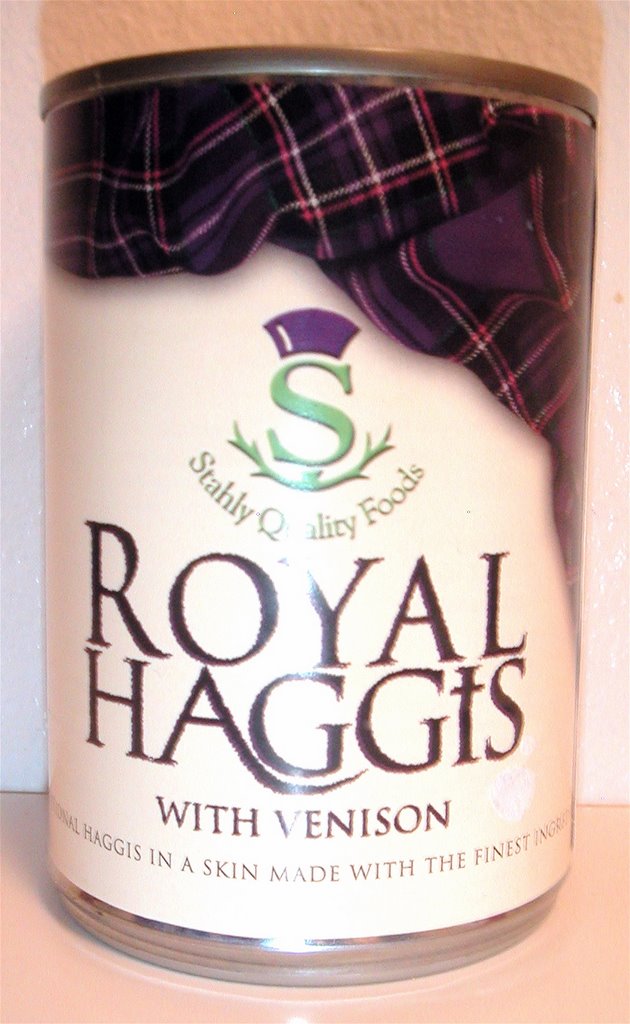
Canned Haggis and Other Culinary Delights

My dear mom brought me home a couple of cans of Haggis when she went to Scotland last month. I was thrilled. I hadn't had any since my aunt made some a few years ago. I don't count my visit to St. Andrews, the Scottish-themed bar and restaurant near Times Square in New York. The haggis there tasted weak, unseasoned.

What exactly is haggis? It's offal. Pardon the pun. But it is -- according to an article I found in The Scotsman (where else?)--
"Haggis is made from lamb offal, most commonly lungs, sometimes beef fat, oatmeal, onions and seasoning particular to each maker, which can include such additions as white pepper, mace, thyme, salt and coriander. They are boiled or steamed and careful measurement of the amount of filling is required to ensure that the grains swell by the right amount to fill the skin. It is possible to make haggis in a domestic kitchen but as the casing is traditionally sewn shut the method requires the cook to also be handy with a needle."
That casing is sometimes a sheep's stomach.

As Scottish as haggis is, there are apparently those who argue that its origins lie in France or Scandinavia. The word haggis may come from the Swedish word for 'chop,' which is hagga (so say Scottish haggis purveyors the MacSweens).

The English writer P.G. Wodehouse supposedly wrote that he never liked haggis on account of Shakespeare's Macbeth:
There is no doubt that Shakespeare has rather put us off the stuff.... You remember the passage to which I refer? Macbeth happens upon the three witches while they are preparing the evening meal. They are dropping things into the cauldron and chanting "Eye of newt and toe of frog, wool of bat and tongue of dog," and so on, and he immediately recognises the recipe. "How now, you secret, black and midnight haggis," he cries shuddering.
I read somewhere that there are scholars that believe that it was haggis -- bad haggis -- that caused Macbeth's hallucinations. I want desperately to believe that.

For contemporary Scotland, haggis is forever linked to one of its favorite sons, the great poet Robert Burns. Rabbie Burns, as he's affectionately called, wrote "Auld Lang Syne," the song we associate with New Year's Eve. Burns (1759-1796) was a poet, a farmer, a tax collector, father of many illegitimate children, and a Freemason.

My first taste of haggis was at a Burns Night Dinner at a Masonic Lodge. Freemasons and Scots alike celebrate Burns Night every January 25th, the poet's birthday. An essential part of every Burns celebration is a recitation of his great poem, "Address to a Haggis," which is written in such a thick Scottish dialect as to be near incomprehensible to the modern American. Here it is in full:
Address to a Haggis.

Fair fa' your honest, sonsie face,
Great chieftain o the puddin'-race!
Aboon them a' ye tak your place,
Painch, tripe, or thairm:
Weel are ye wordy of a grace
As lang's my arm.

The groaning trencher there ye fill,
Your hurdies like a distant hill,
Your pin wad help to mend a mill
In time o need,
While thro your pores the dews distil
Like amber bead.

His knife see rustic Labour dight,
An cut you up wi ready slight,
Trenching your gushing entrails bright,
Like onie ditch;
And then, O what a glorious sight,
Warm-reekin, rich!

Then, horn for horn, they stretch an strive:
Deil tak the hindmost, on they drive,
Till a' their weel-swall'd kytes belyve
Are bent like drums;
The auld Guidman, maist like to rive,
'Bethankit' hums.

Is there that owre his French ragout,
Or olio that wad staw a sow,
Or fricassee wad mak her spew
Wi perfect sconner,
Looks down wi sneering, scornfu view
On sic a dinner?

Poor devil! see him owre his trash,
As feckless as a wither'd rash,
His spindle shank a guid whip-lash,
His nieve a nit:
Thro bloody flood or field to dash,
O how unfit!

But mark the Rustic, haggis-fed,
The trembling earth resounds his tread,
Clap in his walie nieve a blade,
He'll make it whissle;
An legs an arms, an heads will sned,
Like taps o thrissle.

Ye Pow'rs, wha mak mankind your care,
And dish them out their bill o fare,
Auld Scotland wants nae skinking ware
That jaups in luggies:
But, if ye wish her gratefu prayer,
Gie her a Haggis!
The word 'sonsie' in the beginning apparently means 'cheerful.' See the link above for a more complete translation of the poem.

Haggis is traditionally served with "neeps" and "tatties," which are mashed turnips and mashed potatoes. These particular turnips are known in America as rutabagas. However, as the Scotsman's Jane Laidlaw notes,
It goes well with pheasant, chicken and steak, and makes a good stuffing for onions and baked potatoes. Haggis Cannelloni, Ravioli and Lasagne sound culturally mixed-up to someone who hasn’t tried them but there is no reason haggis and pasta shouldn’t integrate as happily as Scots and Italians.

And though it may sound like a gross oxymoron, there is, thanks to an enterprising Scot named John Macsween, a vegetarian haggis, a concoction made with kidney beans and lentils. An Edinburgh butcher recently introduced a halal haggis for Muslims after lots of requests. An Indian food company in Scotland makes haggis samosas. During my last trip to Scotland I became fond of a deep-fried and battered haggis I found at an Edinburgh chip shop. Whatever variety you choose, just make sure you serve it with a bit of scotch. And perhaps a glass of Irn Bru, Scotland's other national drink.

I enjoyed my first can of haggis with a bit of both, along with a splash of whisky over the haggis itself. I managed to mash some potatoes (or rather my dinner guest did), but I wasn't able to procure those blasted rutabagas. I'm afraid I don't know where to look. Are they out of season? Who knows. But my dinner was superb.


Haggis resources on the web:

Labels:

Site Meter