Thursday, September 30, 2010

Quote of the Day: Steve Albini

I'm a big fan of musician and sound engineer Steve Albini, partly for his band, Shellac, and partly for what he's said about the music business. (See my post from last November about his article "The Problem With Music".)

So I was delighted to read an interview with Albini on GQ.com. He's articulate and opinionated, and not entirely negative about the state of the music business today.

But the best part was his response to the very last question, How would you describe your fashion?
"I think fashion is repulsive. The whole idea that someone else can make clothing that is supposed to be in style and make other people look good is ridiculous. It sickens me to think that there is an industry that plays to the low self-esteem of the general public. I would like the fashion industry to collapse. I think it plays to the most superficial, most insecure parts of human nature. I hope GQ as a magazine fails. I hope that all of these people who make a living by looking pretty are eventually made destitute or forced to do something of substance. At least pornography has a function."

Labels: ,

Friday, November 06, 2009

Quote of the Day: Hank Pantier

"If you stuff five pounds into a two-pound container, it doesn't make the five pounds smaller. It just makes it stranger-looking and uncomfortable."
Colorado man Hank Pantier, 35, is talking about his wife, 40-year-old yoga instructor Mary Pantier. She's one of thousands of American women who pack themselves, sausage-like, into modern-day spandex corsets from Spanx.

The Wall Street Journal discussed the ins and outs of Spanx -- which has been endorsed by Oprah -- in a recent article featuring some horror stories. For example, women find themselves trying to secretly ooze out of these products before one-night stands; others find it difficult to use the bathroom. Hank Pantier tells his wife she feels like a tire when she wears Spanx.

Labels:

Thursday, August 27, 2009

Quote of the Day: Paul Mooney

“If your hair is relaxed, white people are relaxed. If your hair is nappy, they’re not happy.”
So says comedian Paul Mooney in Chris Rock's new documentary "Good Hair". Mooney was quoted in the New York Times yesterday in an article that explored the politics of black women's hair. Is it selling out to straighten it? Is not straightening it a political statement? Or is it fashion? Or is it convenience?

Michelle Obama straightens her hair. But when her 11-year-old daughter Malia wore her hair in twists for a trip to Rome, the conservative blogosphere reacted bizarrely.

“For black women, you’re damned if you do, damned if you don’t,” said UC Santa Barbara professor of black studies Ingrid Banks, quoted in the Times article. “If you’ve got straight hair, you’re pegged as selling out. If you don’t straighten your hair, you’re seen as not practicing appropriate grooming practices.”

So which is "blacker," straightening or not straightening? And why is highlighting and dyeing not considered unnatural? White women with curly hair straighten, too, and white women get extensions. And yet the fact that the desire to modify one's hair is universal doesn't seem to make the issue less racial for black women.

Labels:

Thursday, June 04, 2009

Further Proof That America is Crumbling

This breaking medical alert from a Yahoo fashion and beauty page: "Why not to wear skinny jeans: nerve damage." OMG! That's like frightening. According to Yahoo, which is according to MSNBC and CBS,
"One skinny jean wearer, Parmeeta Ghoman, went to her doctor because it felt like she was like 'floating' and she couldn't like feel her legs. 'It felt really, like, strange — it felt like my leg had gone to sleep,' says Ghoman. Another woman from this CBS report said her jean pain was so bad that her doctor now has her taking anti-seizure medicine to control her symptoms."
(All likes mine, inserted for realism.)

“I’m the kind of person who buys shoes two sizes too small just because they’re cute — and they’re on sale,” admitted the hapless Ghoman.

But wait, there's more! Says MSNBC, "And in the 1970s, rumors circulated of snug jeans causing infertility in men and yeast infections in women." Somebody should do something.

Labels:

Quote of the Day: Michael Bastian

“It’s crazy, I can’t even afford my clothes.”
Poor Michael Bastian. The designer of $600 cut-off shorts told The New York Times' David Colman that in an otherwise glowing article this week.

Bastian's menswear is made in Italy, and he told The Times that it may not last if his manufacturer can't cut costs by 30 percent. “Right now, it hurts a little too much. It should hurt a little, but it shouldn’t kill ’em. That’s the law of designer clothes.”

As the economy continues to tank and schadenfreude sets in, it's awfully tempting to dismiss the over-grown luxury sector. But.... But what? I'm sorry I have no sympathy if you can't sell a $425 dress shirt, not now, not in any economy. Such grotesquely priced apparel should never be more than a miniscule niche market. Come on. I can get a beautiful dress shirt made exclusively for me to my exact specifications by American workers right here in the New York area for half that.

While Bastian's designs are lauded for being wearable right off the runway (a relative rarity even in menswear; Bastian says, "The easiest thing is to create something no one has ever seen before. There’s a reason no one’s ever seen it — because someone tried it, and it didn’t work in the real world.”), wearable should not be confused with affordable. It's still a brand and it's still very high-end. Ultimately, Bastian's customers are spending on Italian fabrics and construction, but also on his name. Standard mark-up in the apparel world is more than double, which is why retailers can still make a profit after big sales.

However, the luxury apparel market is beginning to see that it may have suffered a permanent loss. The simple fact is that we got too greedy. The first sign of the retail apocalypse was when Chinese knock-off accessories (handbags, sunglasses) became acceptable among otherwise scrupulous women. As a cultural demand for luxury outpaced middle class pocketbooks, the culture compensated by allowing imitations and forgeries. Stories would circulate that these fake Chanel shades were made in the same factory as the real ones -- they were only fake because they weren't sanctioned by Chanel.

We've been forced to re-examine what luxury is and who deserves it. Is it merely exceptionally high-quality goods? Or is it just arbitrarily expensive goods? Is it gauche to show logos? Should we hide our purchases in plain bags? Does anyone give a shit? Is saving money right now and paying down debt un-American?

Labels:

Monday, May 18, 2009

Quote of the Day: Anna Wintour

“I had just been on a trip to Minnesota where I can only kindly describe most of the people that I saw as little houses, and I just felt like there’s such an epidemic of obesity in the United States. And for some reason everyone focuses on anorexia ... We need to spend money, time, and education on teaching people to eat, exercise, and take care of themselves in a healthier way.”
Anna Wintour is the editor of Vogue and perhaps the most powerful person in fashion. She bad-mouthed my home state on yesterday's episode of 60 Minutes.

Yes, she's a hostile stick figure with hair like a starched curtain framing alien eyes above a skeletal nose, and yes I resent the likes of her singling out the 30th fattest state in the nation as an example. (Mississippi ranked worst, West Virginia second and Alabama third.)

But if she's saying that Americans are overweight and do not care much about the way they dress, she's right. We in America dress more for comfort and, paradoxically, prefer clothes that are made for action even while we languish indoors. We like track suits and running shoes for things like riding on planes and shuffling through malls.

Then again, have you seen models these days? Even in menswear runway shows, they're long and skinny with big heads like Tim Burton characters. We don't talk about anorexia and bulimia nearly as much as we talk about obesity, and maybe we should change that. In fact, Anna Wintour could change that herself.

The video here (which I haven't embedded because it starts automatically -- very irritating) doesn't show the anti-Minnesota bit -- that was in another clip that CBS has removed from the Internet.

Labels:

Sunday, March 29, 2009

Paris


That small orange creature with the blond wig sitting under the enormous Paris Hilton photo is the the actual Paris Hilton. She was at the Vision Expo eyewear tradeshow posing with conventioneers and promoting her new line of sunglasses. As I was taking this snapshot, a cheerful woman in a suit admonished me, "no cameras, please! Cell phones are okay though!"

Labels:

Monday, March 23, 2009

Carmen Dell’Orefice

While at a small charity gathering I was covering for work, a PR person I was talking to leaned over and told a couple of photographers to be sure to snap some pictures of the woman coming down the stairs. 'Who is it?' I asked. 'It's the world's first supermodel,' she said reverently, 'Carmen Dell’Orefice.'

'Who?' I asked. The woman descending the stairs was striking. She was over six feet tall with a dense and perfect mane of white hair and black movie star sunglasses. "She's like 80 years old and her body is perfect,' the PR agent said. Her posture certainly was. Here was a woman utterly confident in her skin and unashamed of her height and age. And once she saw the cameras, she was even more relaxed.

'She was in Page Six today,' my PR friend continued. 'And she's still modeling -- she's doing an ad campaign for the Pierre Hotel.' Later, she leaned close and whispered that Ms. Dell’Orefice had lost everything to the despicable Bernie Madoff -- 'I don't mean to gossip,' she said, smiling sadly.

She's actually only 77, I learned when I got home. And she was in Page Six, the New York Post's gossip column, today. And that thing about her losing everything to Madoff? It's a feature story in Vanity Fair's April issue.

Pretty quickly, I realized that I had seen the glamorous Ms. Dell’Orefice -- in Target ads. She looks like a caricature of herself in those ads, so air brushed and white and smug. Nothing like the woman who smiled at me warmly as she reached for a glass of champagne.

She's an American, although she looks like she must be French or Italian. She's had an interesting life. She was 'discovered' on a Manhattan bus on 57th Street in the 40s. She posed for Salvador Dalí as a 12-year-old. She was a ballet dancer. Her first Vogue cover came at the age of 15. And they say she's been working steadily for 60 years.

Labels:

Wednesday, December 03, 2008

Dueling Perfume Reviews

Two reviewers, about a year apart, had very strong opinions about the boldly-named "Breath of God" by a perfume company called B Never Too Busy To Be Beautiful:

First, Hadley Freeman writing in the Guardian in October 2007
"So what, you cry, does The Breath of God smell like? Hellfire? Benevolence? Aquafresh?

"Well, rather like religion, everyone seems to take something different from the Breath of God. One guinea pig detects the scent of nail polish remover. Another suggests the gentle bouquet of cheap booze. Personally, it is exactly how I always imagined those vials of liquid used in period dramas to bring pale heroines round after a fainting spell would smell. Almost like -- yes -- a wake-up call. To what, I'm not sure (to have a shower, probably, to scrub it off) but truly, I have felt the breath of God on my neck."
And then Tania Sanchez, co-author of the superb Perfumes: The Guide, writing in this month's quarterly supplement to the Guide
"Such an experiment should be a hot mess. But it’s a triumph, a walk through an autumnal landscape in shades of pencil gray instead of painterly gold, with the sweet biological rot of compost below and dry air touched with woodsmoke above. In structure it is reminiscent of the best of Serge Lutens’s scents, straddling the dark cedar-violet of the Bois fragrances and epic florals such as Sarrasins and El Attarine, and it has a herbal air of archaic medicine, or potions to ward off malice. Surreal combinations—lemon ham, grape leather, bubblegum tobacco, loquat vetiver—rise from its depths each time it comes to attention, hour after hour. Wearing it, I feel a sense of wonder that so late in the perfume game there still can be such profound invention."
Sanchez gave it a rare five stars.

Labels: ,

Tuesday, November 11, 2008

A Dark Day for Corduroy

When I put on my black medium-wale corduroy blazer this morning, I wasn't thinking about the date. It's November 11, or rather 11|11, the date which most resembles corduroy.

It dawned on me at work when I saw the date coming up in e-mails. Wait a minute, I thought, why haven't I heard from the Corduroy Appreciation Club? Alas, the Club is not meeting this time.

Club leader Miles Rohan listed a number of reasons for the meeting's cancellation this year. Between the bad economy and the election a week ago, the meeting didn't have a chance. Still, Rohan looks forward to the biggest corduroy celebration ever on 11|11|11.

I went to the Club's "secret" meeting last year. Read about it here.

Labels: ,

Wednesday, September 10, 2008

Quote of the Day: Kim Hastreiter

I was scanning the Internet for some proof that it really was Paper Magazine founder Kim Hastreiter I saw at the Zegna fashion show this week, when I found this quote:
“I really never understood the next big thing. How can someone be a genius this season and next season they’re not?

“This completely drives me crazy. Everyone can be raving one season about how great a designer is and then the next season they’re dumped.

“[People do not become] un-brilliant. Designers really suffer from this because you get lifted up and put in this place and then someone else comes along and is put in that place and it’s never really about the work.”
That's from an article last week by Guy Trebay in the New York Times.

Labels:

Wednesday, June 04, 2008

A window at Saks on Fifth Avenue.

Labels:

When Your Chastity Belt Doesn't Go With Your Shoes

"What? Who is this? What time is it? Are you drunk? Okay, okay, I'll be right over. Just let me put my abstinence pants on."

Sweat pants that "boldly proclaim just where she stands by pointing out that 'True Love Waits' in a large screen print on the front and back" are available for $16.99 at kmart.com.

[from Racked L.A. via Think Progress.]

Labels:

Saturday, April 05, 2008

From a fashion presentation in SoHo for Cuyo, a new Japanese streetwear brand.

Labels:

Monday, February 04, 2008

It's Fashion Week Again

Feel an extra chill in the air? It's Fashion Week again in New York, a time when names are dropped from loftier heights and noses reach more radical angles. When Anna Wintour sightings are rampant. When low-level fashion writers can feel like bigshots because they can use the press line and pass all the ticketed wealthy men and women of leisure.

Here are a couple of hazy snapshots from the John Varvatos show on the 49th floor of 7 World Trade Center. It's the first building on the site to be rebuilt, and until the top five or so floors are rented out, it's a party site. The view is jaw-dropping. The photo below shows the Woolworth Building with one of the bridges -- I think it must be the Manhattan Bridge -- in the background.


Like the Perry Ellis show I went to last Fashion Week, I was stunned to discover that what I thought was five different models changing outfits six times was actually 30 different models who looked like five sets of clones.


The show was well-attended, but because of the high location, a few people started a rude dash for the elevators when they thought the show was over. It wasn't yet. That's the downside of holding a twenty minute fashion show on a high floor.

Labels:

Sunday, September 16, 2007

Quote of the Day: Lynn Hirschberg on Sloppy Rich People

"I have long believed that leisure wear is one of the great evils of our times. Scientists should stop investigating the links between fat friends, fast food and obesity and concentrate on the pernicious impact of stretch fabric. When a waistband can give and give, why should anyone stop eating? When a shirt does not need to be tucked in, who cares about the belly beneath? Lycra has changed the physique of this country, especially among men. With stretch in their play clothes, restraint is gone. A suit is suddenly uncomfortable and buttons pop; why not go for something loose?"
That's Lynn Hirschberg sounding indignant in T Magazine, the style supplement of the Sunday New York Times.

As much as it may sound like a jab at the lower classes, she's referring specifically to super-rich business men like Harvey Weinstein, pictured at left at an invite-only captains-of-industry media conference in Idaho earlier this year. "Harvey Weinstein's fashion stock is plummeting," reads the caption to the photo as it appeared in the Times.

That caption is especially funny because Weinstein is a co-owner of Halston, as Hirschberg points out.

"Thirty years ago, these men would have felt compelled to wear seersucker or linen suits, full-length pants or proper button-down shirts," Hirschberg laments. "They would have felt that their station in life demanded a certain decorum, a prevailing sensibility that extended to their attire."

I would argue that as time goes on, dressing well, whatever that actually means, gets harder for men. It's because the traditional uniforms of work and leisure are being switched and rearranged.

Ironically, men of my generation can wear a suit and feel like they are expressing their individuality, instead of conforming. We have the Harvey Weinsteins of the world to thank for that. Like my father and most baby boomers, they've tired of suits and ties; they've decided they're aged enough and successful enough that they can wear anything they want. (I should note that my father dresses much better and much more consciously than Mr. Weinstein.) In many cases, this new freedom means laziness, not just comfort and choice.

Hirschberg notes that this laziness in dress among the rich is limited to American men; women still have to think about what they wear, and successful European men still dress smart.

It seems that we're always comparing ourselves to those damn Europeans. "French women don't get fat," for example. We're sensitive to these influences (evidence: "freedom fries"). We should be. Did you know that one of our most celebrated American sit-coms, All in the Family was based on a British sit-com? And the new CBS show, Viva Laughlin is based on a British series, too.

Any community is going to be known as an amalgam of its antecendents until those sources are forgotten and the community can come out as its own spontaneous creation. But will America ever have its own style? Something that isn't known as a relaxed version of an English creation, like the loose-fitting sack suit Brooks Brothers sold?

Such a rant must sound horribly elitist. A well-educated cultural critic could make a good case for a subconscious longing for Empire and days of British rule, that big daddy that our little Oedipus America murdered centuries ago. And of a desire for structure and rules -- like a tantrum-prone child crying out for discipline or perhaps a "savage" Indian subcontinent eager to adopt its conquerer's buttoned-down sartorial sense. (Please excuse my sarcastic treatment of cultural criticism.)

Liberals will be reflexively suspicious of such calls to fashion. Uniforms and fancy clothes reek of power displays and the social hierarchies most leftists would like to either smooth over or pretend don't exist. Wouldn't we all get along better if we all dressed casual?

But whatever the influences or subconscious sources, I think and work better when I'm clean, well-groomed, and well-dressed. Hirschberg again: "Too much power has made men arrogant and surprisingly unaware. Their clothes reveal more than they realize — sloppiness is more than just an XXL polo shirt; it’s also a state of mind."

Labels:

Tuesday, September 11, 2007

Don't Hate Me Because I'm Beautiful

All you haters aren't qualified to understand Fashion Week.

Labels:

Sunday, February 25, 2007

Why Are Models So Thin?

A list of possible reasons for the trend of life-threateningly thin runway models in today's fashion world, gleaned from Emily Nussbaum's New York Magazine article "The Incredible Shrinking Model".
  • The "Aspirational Theory": we all -- but especially those who would buy the expensive clothes modelled on runways -- want to be thinner. Ultra-thin models are that peak we all strive for.

  • The "Blank Canvas Theory": clothes look better on a body that doesn't bulge anywhere, a body that the clothes can overpower. "And the better the clothes are, the more extreme the skinniness must be," writes Nussbaum, of this theory.

  • The "Hanger Theory": a variation on the blank canvas, this theory says that since clothes hangers cannot walk, the women should be more like clothes hangers -- just a frame to hold the garment up.

  • The "Cycles of Fashion Theory": every possible body type will one day be in vogue because fashion, like everything else, needs change to show people something new. "The Gibson girl gives way to the flapper, then to the big-shouldered forties girl and her busty fifties counterpart, and on to Twiggy, the eighties Amazons, Kate Moss, the waifs, and heroin chic ..."

  • The "Anti-Obesity Theory": Americans are really fat these days, and the fashion world is striking back. Fat = Poor, Unsophisicated, and Out-of-Control. Skinny is the opposite.

  • The "Tautology Theory": As Nussbaum writes, "The clothes are on very thin girls, so clothes must look best on very thin girls."

  • The "Anexoria Nervosa Theory": Models aren't thin. What are you talking about?

  • The "Supermodel Backlash Theory": this is the inevitable reaction to the 80s and 90s era of highly paid, statuesque, Amazonian supermodels -- the Cindy Crawford, Naomi Campbell, Christy Turlington, Claudia Schiffer era. The industry is merely correcting itself by making models less famous, less highly-paid, and, naturally, less there at all They are literally smaller and thinner to compensate for the over-sized public images of their famous predecessors.

Labels:

Saturday, July 15, 2006

Designer Originals

When I was in ninth grade, my friend Alyssa told me about a local biker gang called the Hell's Outcasts. We were at a downtown St. Paul headshop buying our trademark black t-shirts (Megadeth, Overkill, etc.) when we ran into the man Alyssa told me was the gang's current leader. He was a slight man of about thirty. He wore a leather jacket and jeans, and I don't remember much else about his looks. I don't know how my friend Alyssa knew this guy, but he seemed friendly enough.

Later, Alyssa told me gang's policy on clothes, which she may have just taken from Hunter Thompson's book Hell's Angels. For all I knew, the Hell's Outcasts got it from Thompson's book. The idea was this: new recruits have a pair of jeans that are called his originals. He can't take them off until they fall off, even after the rest of the gang's shit, piss, and puke are installed on said dungarees. There are variations on this, of course, but that's the gist of it.

Before you quibble with the practicalities of wearing jeans soaked in feces to work (even bikers have jobs, right?), think about how much a pair of originals would sell for in a Soho boutique. That's right, take the jeans after, say, a month of rough wear (all human fluids included, plus the inevitable motorcycle fluid stains, road rash, and cigarette burns) and wash them. Wash them again. Get the smell out. Then have the biker who wore them scrawl his name on the back with a marker and put a $1,000 price tag on them. I guarantee this will sell.

This is what I was thinking about when I read the article "Yeah, They Torture Jeans. But It’s All for the Sake of Fashion." in the business section of the Times last week. There we learn about "Italian industrialist" Giovanni Petrin and his disastrous first attempt to stone wash jeans the way the Japanese do. The stones shreded his jeans and mangled his industrial washing machines. "The stone is actually pumice," he later learned. Petrin's company Martelli is making a fortune off rich hispters who want to wear clothes that make them look as if they work for a living:
Martelli posted $140 million of revenue in 2005 not by making any of these jeans, but by providing the skills and technology to transform them from new to old-looking. It was largely thanks to those like Mr. Petrin, who helped build the new “old” look by combining fresh styling with innovative manufacturing skills (he has a small secret here), that weathered jeans became the object of desire in America’s $15 billion jeans market.
Petrin uses cheap Chinese labor ("We tried Romanians, and we tried Africans. None were as good as the Chinese.") to "stylize" jeans made in Morocco and Turkey for "Armani, Dolce & Gabbana, Yves Saint Laurent, Calvin Klein and Donna Karan, but also mass-market brands like Levi Strauss, the world’s biggest jeans maker, the Lee and Wrangler brands of the VP Corporation, Gap and Zara." Their methods are actually quite fascinating:
In their main factory, with 900 workers, huge washing machines tumble jeans with pumice gravel; workers in face masks slip jeans legs over inflated balloons, which then move robotlike between sets of abrasive plastic brushes that scrub the denim to give it a worn look. Other workers brush creases into the jeans that, because they fan out from the fly, are called whiskers.

The work elsewhere is more labor-intensive. Here, workers apply discoloring chemicals with brushes; there, they use hand-held guns to blast jets of quartz sand. Assembly line workers hold the edges and cuffs of jeans to spinning abrasive pegs that wear them down or make holes in them.

Some apply embroidered designs, others rhinestones, still others stitch patches over holes they have just cut. Even though most of the jeans look thoroughly ruined by the time they leave his factory, Mr. Petrin says: “If they ruin a pair, they pay for them.”
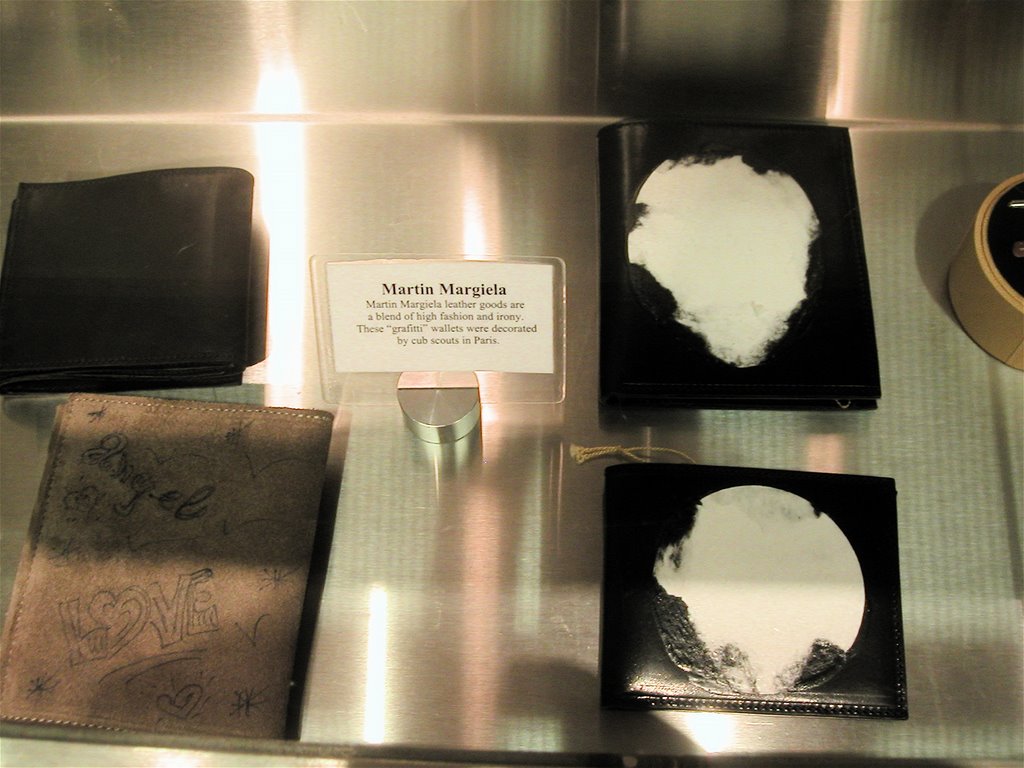
So let me return to my original idea. Distressed jeans with a record. A little more verity. Wouldn't people pay more for clothes that were damaged by individuals instead of a factory collective? That seemed to be the idea behind these wallets I found at Takashimaya last weekend. The card in the display case says the designer is Martin Margiela, and that the wallets "are a blend of high fashion and irony." The clincher: "these 'grafitti' wallets were decorated by cub scouts in Paris." I don't know quite what to do with that. Maybe that's just the verity I'm looking for with my "originals" concept jeans. Cub scouts, bikers, the possibilities are endless.
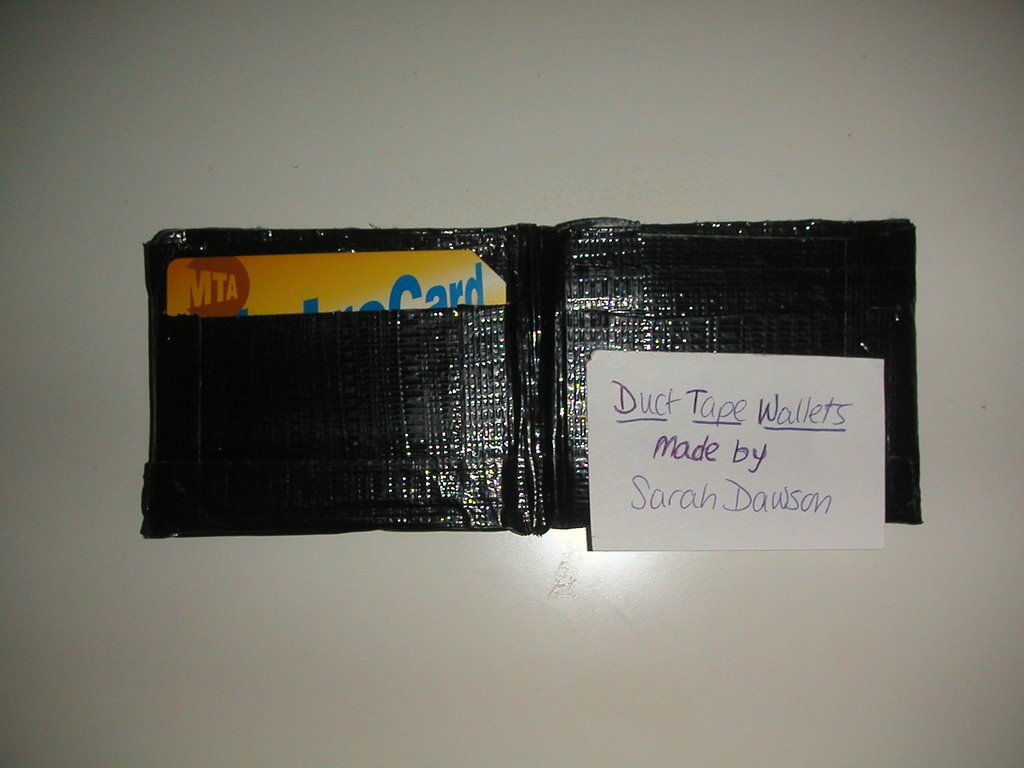
I've got my own designer wallet: a duct tape wallet hand-made by Sarah Dawson, a thirteen year-old Brooklyn student. She's my boss's daughter, actually. I've been using this high-fashion wallet for about a month now, and I just love it. It was free, and I kind of feel guilty about that. She used to sell them for around $10 to her classmates, but she stopped when she ran out of classmates. I got one free as an example. If you want one, I can one for you. But I have to warn you, my markup is 300%.

Labels:

Site Meter