Tuesday, August 31, 2010

My New Blog


Anyone who checks The Masticator regularly will have been disappointed by a dearth of activity. While I'm not giving up on this blog, I have been focusing my energy on another one: Cocktails & Cologne, a blog about...cocktails and cologne.

Here's my first post, explaining the idea:
What do cocktails and cologne have in common? Both are careful concoctions designed to delight our senses, and in different ways, to intoxicate. Beyond my passion for these elixirs, one for the palate and the other for the nose, they are connected as expressions of masculinity and refinement.

My favorite cocktails are the ones that have few ingredients and don’t try to hide the alcohol with fruit or sugar. I like things bitter sometimes, or spicy. I like to be surprised by new variations or novel ingredients. And while it’s exciting to try an exotic infusion, like the bacon bourbon I recently tried at New York’s PDT (one of the most innovative cocktail bars in the City, hidden inside a hot dog shop), I prefer drinks I could make at home.

For colognes and other men’s fragrances, I like things that remind me of the past, but I’m always looking for something totally new. I’ve discovered that floral scents can be masculine and that some classically masculine scents would, in any other context be considered quite feminine. I prefer subtlety and elegance over bombast. I appreciate luxury but I’d rather have quality, and I’m convinced that quality can come at a modest price.

In both cocktails and cologne, I honor the classics while I search for the unique. This blog will chronicle my search with reviews, recommendations, recipes and stories.
Photo above by Morgan Sheff.

Labels:

Tuesday, May 04, 2010

Beverage Deception

“Whether it has caffeine or not is not really important to me,” said the owner of a Manhattan donut shop, after being accused of serving decaf coffee and passing it off as caffeinated. “I like the flavor like I like the flavor of chocolate.”

This revelation came from a customer who had been drinking coffee there for a year. You want to think that they’d always suspected, but who knows?

It reminds me of a delicious (and expensive) cocktail I had at Pegu Club last weekend, a bar famous for meticulously made classic mixed drinks. It was called a “Whiskey Smash,” and I ordered it because it was their version of a mint julep (the Kentucky Derby was on, and a Southern cocktail seemed appropriate). It was very tasty, but I could barely detect the whiskey.

I had watched the bartender make it—sort of. And when I thought about it, I didn’t see him pour any booze. Was it possible that this highly skilled mixologist had skipped the most important ingredient? Or was it just so expertly proportioned that the alcohol flavor was subtle, even absent? To be honest, the reason I didn’t ask the bartender about it was because I didn’t want him to be embarrassed if he really did miss it somehow. This, I think, is a very Minnesota reaction.

The recipe, created by the famous mixologist Dale DeGroff, is online at the archived Gourmet Magazine site:
3 lemon pieces (cut a lemon in half and then quarter one of the halves, use three of the quarters)
5 mint leaves
1 ounce simple syrup
1 1/2 ounces Makers Mark Bourbon
Lemon wedge for garnish
1 mint sprig for garnish
I tried it at home, and...it tasted just like the one at Pegu Club, which is to say it was delicious, but not boozy. Who knew whiskey could be so mild?

My girlfriend told me a story once about a bartender at Bar Abilene, a Tex-Mex establishment in Minneapolis's Uptown neighborhood. The bartender, a bitter and work-averse sort, was upset by special orders: if a customer asked for a margarita frozen, instead of up, as it's listed on the menu, he would punish them by serving it without any liquor in it. No one noticed, of course. He apparently confided this with some pride to a fellow bartender at another Uptown bar.

This in turn reminds me of another beverage deception. In 2005, some food and wine critics at the New York Times participated in a blind taste test of 20 premium vodkas, with mid-market Smirnoff thrown in as a ringer. And it was Smirnoff, of course, that won, beating out all the Grey Gooses (it “was felt to lack balance and seemed to have more than a touch of sweetness”), the Ketel Ones (it “was felt to be routine and sharp”).

Wrote wine critic Eric Asimov, “What set Smirnoff apart, we agreed, was its aromas and flavors, which we described as classic.”

I chortled, vindicated, as I read this five years ago. Thinking about all the suckers who fell for the marketing of expensive but ultimately flavorless vodkas. (And then I thought about how excited I was to bring home a bottle of Russian Standard vodka from a trip to St. Petersburg. Okay, I’m guilty too.)

We all like to think that we'd be able to detect a placebo, to spot an ambush in a blind taste test. But the same problem exists in other categories, like art. How gleeful we become when we hear about art critics unwittingly praising the scribbles of children or animals as "genius" and "deliberate." Context is everything: marketing will fool us into thinking Coke tastes better than Pepsi, a desire to please will steer us toward one thing over another, and a high price or well-placed praise will boost the stature of the lowliest crap.

Labels:

Saturday, October 03, 2009

The Bronchitini

When confronted with a nearly empty liquor cabinet and a yearning for a cocktail, One must innovate. After a recent bout with bronchitis, I found that I had a nice stock of cherry-flavored cough syrup. A new cocktail was born.
Ingredients:
2 ozs. gin
one-quarter tsp cough syrup
Start with a chilled martini glass. Swirl the quarter tsp of cough syrup in the glass to coat it. Shake 2 ozs of gin in a cocktail shaker with ice to cool it. Pour gin into the cough syrup-coated martini glass.

Notes: I've attempted this drink with a cough drop as a garnish, but it becomes sickly sweet. The beauty of the cough syrup is that it's sweet, but not too sweet. A tiny bit adds a bittersweet edge to the gin, and flavors it quite subtly. I used prescription cough syrup, but over-the-counter varieties would certainly work. I'd avoid children's cough syrup (too sweet). The amount of codeine in a quarter tsp of cough syrup will be negligible, so go ahead, make two.

Labels:

Cilantro Cocktail

This is adapted from a drink called a "Puebla" served at Applewood in Brooklyn.
Ingredients:
2 ozs. tequila
2 quarter-inch slices of jalapeño
1 lemon
1 tsp agave nectar
lots of fresh cilantro
Pack a third of a large lowball glass full of cilantro leaves. Squeeze the juice of one lemon into the glass. Add jalapeño slices (the more seeds you leave in, the hotter). Muddle. Add tsp of agave nectar to sweeten it, then add two ozs of tequila.

Shake everything in a cocktail shaker and strain into a large lowball glass with three ice cubes and garnish with cilantro.

Notes: It's easier to muddle in a short glass, rather than a cocktail shaker. Lemons seem to work better than limes in this drink. Honey may be reasonable substitute for agave nectar, but I haven't tried it. The true amount of cilantro will vary by taste, but aim for about one loosely packed cup. Using better tequila will be rewarding.

Labels:

Friday, July 18, 2008

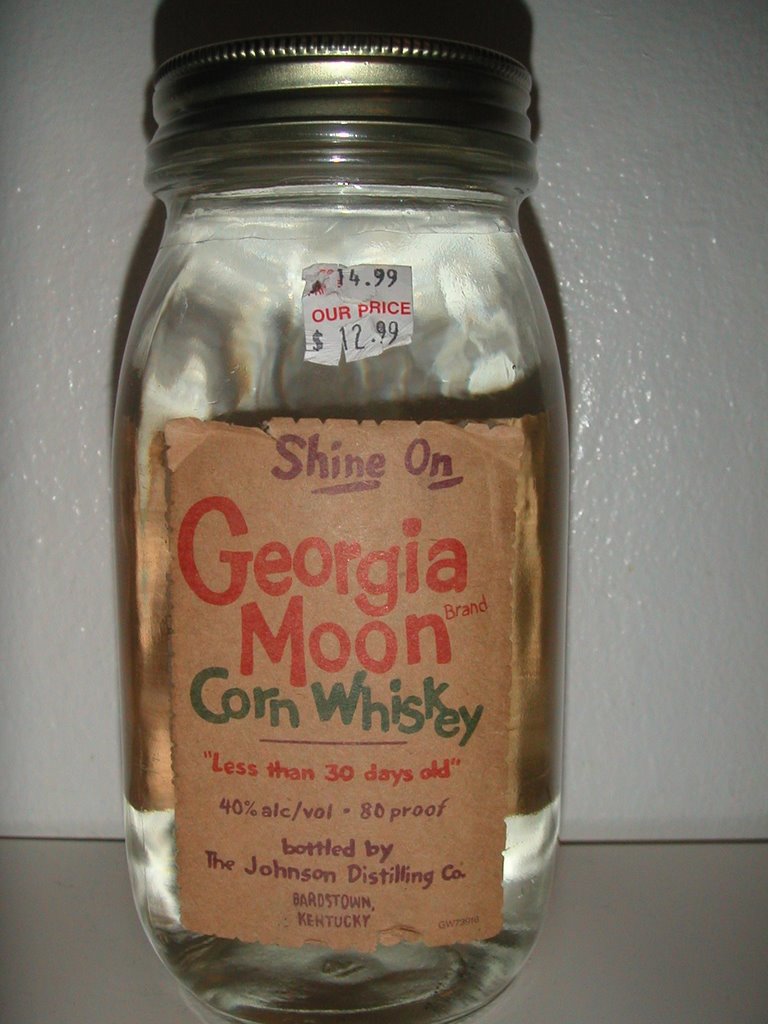
Repost: Review: Georgia Moon Brand Corn Whiskey

I wrote the post below in about May of 2006, and for some reason, it continues to generate comments. Just got another today. I have no idea how people find it; a search for the name brand Georgia Moon doesn't bring it up immediately. Maybe I ought to write about booze more often.

And I keep seeing this odd little gimmick in New York liquor stores. A little wine shop opened up in my neighborhood in Brooklyn recently, and it stocks Georgia Moon next to the good stuff like Maker's Mark (which has really gone up in price over the last few years). For the Brooklyn hipster, this product is the physical embodiment of "slumming" in a pre-fabricated, pre-distressed dive bar full of faux working class drinkers.

After more than two years, I still have my bottle. It sits under the kitchen sink next to my stock of mouse poison and bleach.

Here's the original post from 2006:


What a concept. It comes in a mason jar, and it's cheap. It boasts being "Less than 30 days old," but if the dust on the lid is any indication, the boast is merely marketing. And that, ultimately, is what Georgia Moon Brand Corn Whiskey is really about: a marketing gimmick, and I fell for it. As you can see in the photo, it didn't set me back much.

The word "shine" is on a different line than the word "moon," which is either a lost ooportunity or a way around a law. Perhaps it's inviting some nasty suits to label a commercial product "moonshine." If I were the creator of this product, I would have called it "Kentucky Moon" at a minimum. Why mix states? It's distilled in Kentucky. If Georgia has a richer moonshine heritage, the good folks buying this here jar of swill on Broadway in the Village in NYC don't know about it.

And another thing. Shouldn't a whiskey like this be at least 90 proof? The Kentucky whisky (note the different spelling) Maker's Mark is 90 proof. I would have made a whiskey with an odd percentage of alcohol, like 93 proof. It sounds more authentic.

I haven't mentioned taste yet; I haven't tried it. Hold on, let more pour a glass. There. It's clear, like vodka. It doesn't smell too good. It's hard to pour out of the jar without spilling.

I've never tried "real" moonshine, so I have nothing to compare this to except decent whiskey. This is not decent whiskey. It's almost tasteless -- it has more of an aroma than a flavor. Reminds me a little of bad rum, a little like a Dutch liquor called Corenwijn -- a grain mash mixture distilled four times (according to this.). I got some Corenwijn in Amsterdam a couple years ago. Wouldn't get it again.

Georgia Moon is a product of Heaven Hill Distilleries, Inc., a Kentucky liquor firm that owns dozens of labels in many categories -- vodka, gin, rum, etc. Their best known label may be Christian Brothers Brandy.

The company says this about their corn whiskeys:

"The forerunner and kissing cousin to Bourbon, American Straight Corn Whiskey is defined by the US Government as having a recipe or mashbill with a minimum of 81% corn, the rest being malted barley and rye. Today, Heaven Hill is the sole remaining national producer of this uniquely American Whiskey style, bottling such classic names as Georgia Moon, Mellow Corn, Dixie Dew and J.W. Corn."

For the record, Bourbon is like Champagne in that the product must be from the right place, in this case, Bourbon County, Kentucky. While Heaven Hill says it's the only company making straight corn whiskey, Bourbon, which is at least 51% corn (though usually more like 65-75%, according to this FAQ) is made by lots of companies. Jack Daniel's is a Tennessee whiskey, and it's "charcoal mellowed," another disqualifier in the Bourbon category.

Back to Georgia Moon. This is a "male, 18-34 demographic" product. It's really not bad, but it's an impulse buy and a conversation piece -- not a smooth-sipping Kentucky whiskey for connoisseurs. It's a very self-conscious product, and anyone who gives a damn about authenticity will be too embarrassed to buy it twice. My suggestion: do what your great-grandparents did -- make some in your bathtub.

Labels:

Tuesday, June 19, 2007

Quote of the Day: Roald Dahl

It turns out the famed author of James and the Giant Peach was an opinionated wine enthusiast:
"Wine … tastes primarily of wine—grape-juice, tannin, and so on. ... If I am wrong about this, and the great wine-writers are right, then there is only one conclusion. The chateaux in Bordeaux have begun to lace their grape-juice with all manner of other exotic fruit juices, as well as slinging in a bale or two of straw and a few packets of ginger biscuits for extra flavouring. Someone had better look into this. ... I wonder, by the way, if these distinguished persons know that their language has become a source of ridicule in many sensible wine-drinking households. We sit around reading them aloud and shrieking with laughter."
He wrote that in a letter to the British wine magazine Decanter in 1988 to protest the imaginative and literary turn wine criticism was taking.

But as Mike Steinberger notes in an article called Cherries, Berries, Asphalt, and Jam: Why wine writers talk that way in Slate this week, wine critics "are acutely aware of the mockery their fanciful jargon attracts."

Further, such critics are being vindicated by science:
(For instance, the buttery note often detected in chardonnays is an aroma compound called diacetyl, which is a byproduct of malolactic fermentation [a secondary fermentation that softens the acidity in wines].)
Yes. But the old way of writing cannot be improved by science. One last quote from the Slate article as evidence:
British wine expert Michael Broadbent once likened a wine's bouquet to the smell of schoolgirls' uniforms (no, he wasn't arrested). And the late Auberon (son of Evelyn) Waugh, in his wine column for Britain's Tatler, described one wine as smelling of "a dead chrysanthemum on the grave of a still-born West Indian baby" (no, he wasn't fired, but he and his editor, Tina Brown, were brought before the Press Council to answer charges of insensitivity).

Labels: ,

Monday, March 26, 2007

Lu Mudan Tea

Lu Mudan tea is tea leaves tied together in a flower-like pattern.

It's a display tea that opens up when steeped.

Labels:

Thursday, March 15, 2007

Shootouts, Cocktails

The Action

I was just telling a friend about the shootout last night in Greenwich Village: basically, a guy wearing a fake beard goes into a pizza place on Houston and MacDougal Street and shoots a bartender in the back fifteen times. The shooter drops a bag full of about 100 rounds of ammo and runs out the door. He's seen by two volunteer cops, police auxiliary officers that have uniforms, but no guns. They follow the gunman and he turns around and shoots them near Sullivan and Bleecker. They both die. Armed cops cornered the bad guy and shot him dead shortly after that.

So what's my connection? Very little. But I realized as I was telling this story to my friend that I was inserting myself into it expertly. I talked about how I was in a bar down the street from the initial shooting, on Houston and West Broadway. How I wondered idly why so many police cars were going by as I looked out the windows. I'd love to say that I heard the gunshots, but I was in a noisy bar. I might have heard it and thought it was clatter in the kitchen.

But who knows. As I left the bar with a former colleague, we saw more police cars trying to get through the 10PM traffic jams on Houston. One was a crime scene investigation van (ooh, CSI!). Didn't figure it all out till I got home and watched the 11 o'clock news and saw Bloomberg on the scene.

So that's the action part of the story, and my "man in the bar" commentary on it. If I was interviewed by reporters, the subheading might read: "Area man in bar near shooting says it was a tragedy, damn shame."

The Drinking

But let me tell you about the bar. It's called Pegu Club, and it's named after a British Colonial Officers' club in 19th-century Burma. It's on the second floor of a non-descript cinder block rectangle, and its modest aluminum door has the only sign. I walked by it twice before I found the damn place.

Inside, it's much nicer. It's dark, and there's a slight East Asian feel to the decor, but it's mostly just dark and tasteful.

It's famous for classic cocktails, carefully crafted and well-served by expert old-style bartenders. Ours was a young bloke. We were certain, for a moment, that he was speaking gibberish (damn Brits with their phony accents). But he made a nice drink.

My first choice was a Sazerac, which wasn't on the official menu. It didn't faze our young barkeep. I'd never had a Sazerac at a bar before -- most don't stock all the essential ingredients, like Peychaud's Bitters, an old New Orleans concoction.

The Sazerac, some say, is the world's first cocktail. According to Drinkboy.com, the Sazerac has its roots in the 1830s with a New Orleans druggist named Antoine Peychaud who mixed some herbs together and added brandy as a cure-all for customers. Drinkboy says that in the 1850s, a friend of Peychaud's opened a bar called the Sazerac Coffee House, after a brandy, Sazerac de Forge et Fils brandy, of which he was an importer. He served Peychaud's cocktail there. The drink has changed a lot over the last hundred years, but it's basically Rye whiskey, bitters, sugar, and absinthe. That latter usually has to be substituted -- Pernod is a good stand-in. Peychuad's suggests Herbsaint.

Here's the Peychaud's recipe for a Sazerac:
The Original Sazerac Cocktail
Take two heavy-bottomed 3 1/2-oz. Bar glasses; fill one with cracked ice and allow it to chill while placing a lump of sugar with just enough water to moisten it. Crush the saturated lump of sugar with a bar spoon. Add a few drops of Peychaud's Bitters, a jigger of rye whisky and several lumps of ice and stir briskly. Empty the first glass of ice, dash in several drops of Herbsaint, twirl the glass rapidly and shake out the absinthe. Enough of it will cling to the glass to impart the desired flavor. Strain into this glass the rye whisky mixture prepared in the other glass. Twist a lemon peel over the glass, but do not put it in the drink.
I didn't notice what Pegu Club put into it, but I did notice the bartender's painstaking process and rattling flourish with the shaker. He looked more like a chemist as he added ingredients.

My next drink was the bartender's suggestion, the "19th Century": bourbon, Lillet Rouge, crème de cacao and lemon juice. It came in a stemmed glass with a shallow bowl. I've heard it called a "deep saucer champagne glass," and I've no doubt there's a historical reason Pegu serves many of its drinks that way. My sidecar (my next choice) came in one too, as did our neighbors' martinis. The "19th Centruy" was peculiar. My companion thought it almost tasted like tomato juice. I didn't love it, but it was good to try.

Finally, I ordered a Sidecar, another classic cocktail. Pegu had its signature version, but I opted for a more traditional rendition. It's usually cognac (Courvoisier here), Cointreau, and lemon juice.

Drinkboy relates a story, perhaps apocryphal, of the Sidecar's origins:
the Sidecar was developed during WWI, when a certain regular cusomer arrived at the Ritz [Hotel in Paris] on his motorcycle (replete with sidecar), and asked the bartender for a cocktail that would help take off the chill. The bartender was caught in a dilemma: a drink to remove a chill would appropriately be brandy, but brandy was traditionally an after dinner drink, and his patron was wanting something before dinner. So he combined cognac, cointreau, and lemon juice to mix a cocktail whose focus was on the warming qualities of both the brandy and the cointreau, while the lemon juice added enough of a tartness to make it appropriate as a pre-dinner cocktail.
Sounds nice. Not all these stories are true -- some, like my critical role in the shootout, for instance, may be exaggerated -- but they make great bar conversation.

Labels:

Sunday, July 16, 2006

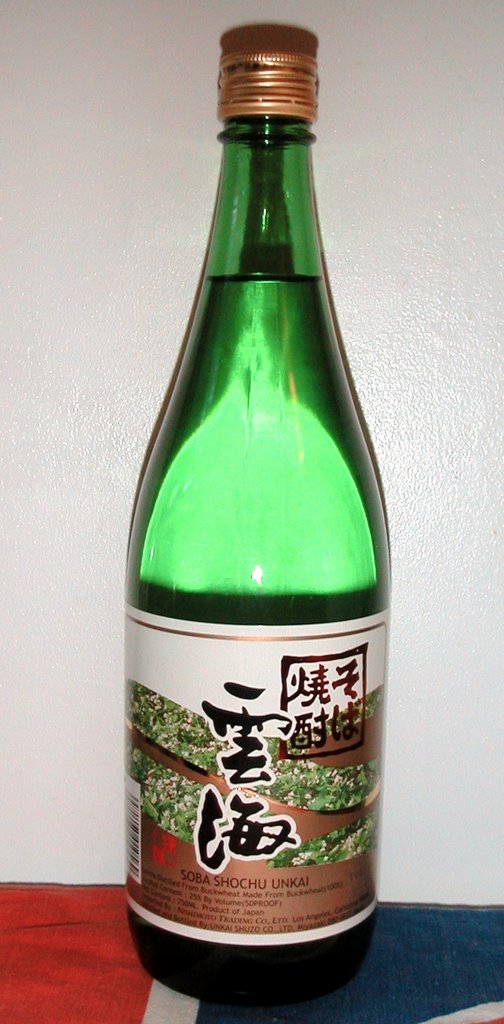
Soba Shochu

I've a new kind of soba beverage -- Soba Shochu. It's a low-alcohol (25%) Japanese liquor distilled from buckwheat. Last week I found Soba Cha, or, buckwheat tea (and I blogged about it here). Back in June, I found a Korean liquor called Jinro (which I blogged about here); Soba Shochu is basically the Japanese (and buckwheat) version of Jinro. Both are tasty in the way a watered-down, mildly sweet vodka would be tasty. It's supposed to be used as a mixer or over ice.

And I thought that was it until I found this website that said this about soba shochu:
The greatest content of Urokinase enzyme that helps human body healthy.
  • Prevent blood clots.
  • Prevent heart diseases.
  • No Hangover.
So, taste the smoothness and enjoy the sensational moment. And get the health benefits of Sobashochu.
Why am I not drinking this all the time?

Labels:

Site Meter